
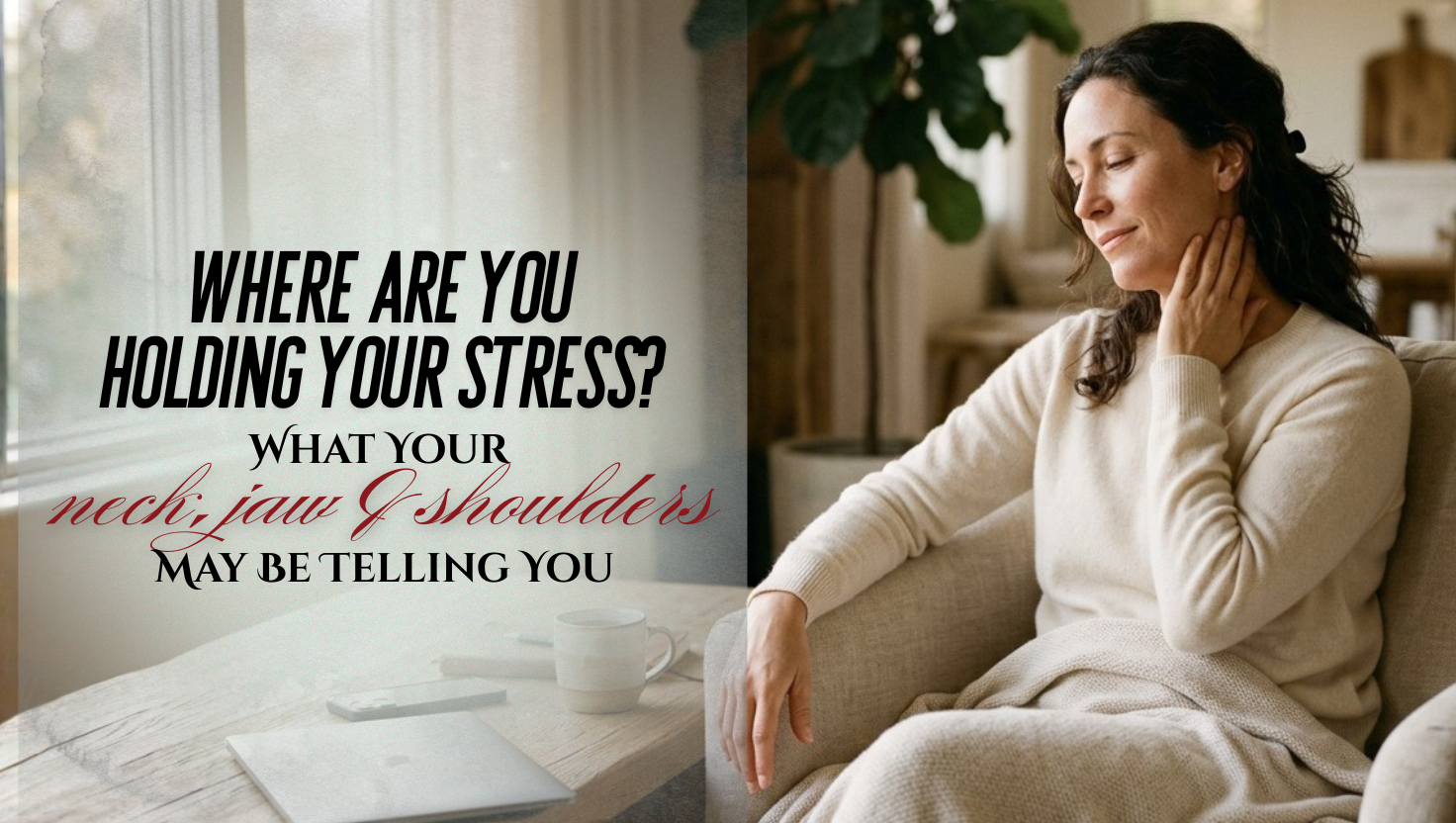
What Your Neck, Jaw & Shoulders May Be Telling You
Stress is easy to recognize when your thoughts are racing or your patience is running thin.
It can be harder to notice when it becomes part of the way you physically move through the day.
You may wake up with a tired jaw. You may realize halfway through work that you’ve been shrugging your shoulders for hours. Or perhaps your neck feels tight every evening even though you can’t remember doing anything that should have strained it.
These sensations aren’t proof that stress is the only cause. Pain and muscle tension can have many explanations. But stress, habits, sleep, posture, workload and repeated muscle activation can interact in ways that make certain areas feel like they are always “on.”
For many people, the jaw, neck and shoulders are where that becomes most noticeable.
Stress Isn’t Always Something You Feel Emotionally
The body’s stress response is designed to help us react to challenges.
In short bursts, that’s useful.
The problem is that modern stress rarely arrives as one obvious event followed by complete recovery. It can look more like:
- back-to-back notifications
- difficult conversations
- deadlines that overlap
- caregiving responsibilities
- long commutes
- poor sleep
- financial pressure
- constant screen time
- never quite feeling finished with work
You may mentally move on from each small stressor while your muscles remain subtly braced.
That doesn’t mean your body is literally “storing emotions” inside a particular muscle. There is no established biomedical mechanism showing that specific emotions become physically trapped in particular body parts.
What we do know is that psychological stress can influence muscle activity, pain perception, sleep and behaviors such as clenching.
Your Jaw: The Tension You May Not Realize You’re Creating
Some people clench their teeth when concentrating.
Others do it during difficult conversations, while driving, while exercising or during sleep.
The National Institute of Dental and Craniofacial Research notes that psychosocial factors including stress, distress and mood may contribute to bruxism, or teeth clenching and grinding. Severe bruxism can contribute to jaw tiredness, headaches and dental damage.
Temporomandibular disorders, or TMDs, are more complicated. They include more than 30 conditions affecting the jaw joint and surrounding muscles, and their causes are not always clear. Stress can be one contributing factor, but it should not automatically be assumed to be the explanation for persistent jaw pain.
A simple awareness check
Several times today, notice your resting jaw.
Ideally, you shouldn’t need to hold your teeth firmly together when you are not chewing.
Try:
Lips gently together. Teeth slightly apart. Jaw relaxed.
The goal isn’t to force relaxation. It is simply to become aware of how frequently you’re clenching without realizing it.
Your Neck: When Mental Load Meets Physical Load
Neck tension can have many contributors, including prolonged sitting, workstation setup, repetitive movements, sleep position and musculoskeletal conditions.
Then add stress.
Imagine spending eight hours alternating between a laptop and phone while:
- answering messages quickly
- worrying about deadlines
- leaning toward your screen
- sleeping less than usual
- rarely changing position
No single factor necessarily explains the discomfort.
Together, however, they create a very different physical environment than sitting comfortably and moving regularly throughout the day.
That is why neck tension often needs more than one strategy.
Your Shoulders: Are They Ever Actually Resting?
Take a moment and notice where your shoulders are right now.
Are they relaxed?
Or slightly raised?
Many people unintentionally brace their shoulders when concentrating, typing, driving or feeling under pressure.
And because it is subtle, the habit can continue for hours.
Try this:
Slowly inhale.
As you exhale, allow your shoulders to drop instead of actively pushing them down.
Then move them gently backward and forward.
Small movement breaks throughout the day are often more realistic than waiting until the end of the week to undo five days of accumulated stiffness.
What About “Emotional Release” During Massage?
People sometimes describe feeling unexpectedly emotional during or after massage.
They may feel peaceful, tired, vulnerable or even tearful.
Those experiences can be very real.
But it is important not to turn them into a medical claim.
There is not strong scientific evidence that massage physically extracts or releases specific emotions that have been “stored” inside muscles.
A more grounded way to understand the experience is that massage provides a period of reduced stimulation, physical touch, focused attention and relaxation. For someone who has been operating under prolonged stress, simply becoming quiet enough to notice what they are feeling can be powerful.
Massage may also help some people with musculoskeletal discomfort, although results vary depending on the condition and comparison treatment. A 2024 systematic review of massage for subacute and chronic neck pain found mixed evidence, with the certainty limited by study quality and differences among trials.
So rather than promising “emotional release,” it may be more accurate to say:
Massage can create space for your body and mind to slow down. What you experience in that space will be individual.
Where Acupuncture May Fit
Acupuncture is another option some people use as part of a broader plan for persistent neck tension or musculoskeletal pain.
Evidence is encouraging in some areas but is not uniform.
A 2024 systematic review found that acupuncture used alongside other care may provide longer-lasting improvement for chronic neck pain, although acupuncture was not superior to sham acupuncture for pain in that analysis. Functional outcomes showed more favorable results.
A later systematic review published in 2025 also reported reductions in neck-pain measures across randomized trials, although study differences and methodology still matter when interpreting results.
That makes acupuncture better understood as a supportive treatment, not a guaranteed fix or a substitute for appropriate medical evaluation. Most patients report having regular acupuncture in the neck, shoulders, and jaw reduces pain, headaches, promotes relaxation, and tension from stress.
5 Things Worth Knowing About Stress & Tension
- Jaw clenching can happen while you’re awake. Clenching and grinding aren’t only nighttime habits. Many people clench during concentration or stressful moments without realizing it.
- Not every clicking jaw needs treatment. Jaw sounds without pain are common and may not require treatment. Persistent pain, restricted movement or other symptoms deserve professional evaluation.
- Stress can influence pain without being the sole cause. Pain is shaped by biological, psychological and environmental factors. Stress may amplify symptoms without being the entire explanation.
- Treatment doesn’t have to be all-or-nothing. Movement, sleep, ergonomics, stress management, dental care, massage, acupuncture and medical care can each play different roles depending on the person.
- Awareness itself can change habits. Simply catching yourself clenching your jaw or lifting your shoulders can give you an opportunity to interrupt the pattern.
6 Ways to Give Your Jaw, Neck & Shoulders a Break
- Check your jaw during the day
– Create a few natural reminders.
– Whenever you send an email, stop at a red light or refill your water, ask: Am I clenching right now?
– Relax the jaw without forcing it. - Move before you feel stiff
– Instead of waiting for discomfort, change position regularly.
– Stand up.
– Turn your head gently.
– Roll your shoulders.
– Walk for a minute.
– Small, frequent movement can be easier to sustain than trying to compensate with one long stretching session. - Look at your screen setup
– If you repeatedly crane your head downward or lean toward your monitor, consider whether the screen, chair or desk height is contributing to the problem. Comfort matters. - Give your nervous system quieter moments
– Not every break needs another screen. Try five minutes without email, social media, podcasts or television.
– Walk outside.
– Drink tea.
– Stretch.
– Sit quietly.
The purpose isn’t productivity. It is reducing stimulation. - Pay attention to sleep
Poor sleep and pain can reinforce one another.
If jaw clenching, headaches or pain are regularly disrupting sleep, that is worth discussing with an appropriate healthcare or dental professional. - Get persistent symptoms evaluated
Stress should never become the explanation for every symptom.
Seek professional evaluation for persistent or worsening pain, jaw locking, significant restriction of movement, facial swelling, dental damage, numbness, weakness, injury or other concerning symptoms.
You Don’t Have to Wait Until You’re Completely Overwhelmed
One of the easiest traps in modern life is waiting for stress to become dramatic before responding to it.
But stress is often quieter than that.
It may be the jaw you didn’t realize you were clenching.
The shoulders that haven’t fully relaxed all afternoon.
The neck that becomes uncomfortable at the same time every evening.
You don’t need to interpret every ache as an emotional message.
Sometimes the more useful question is simply:
What has my body been doing all day, and what would help it work a little less hard?
Rest, movement, massage, acupuncture and other forms of supportive care can all become part of that conversation.
Ready to Give Your Body Some Breathing Room?
If tension in your neck, jaw or shoulders keeps returning, explore how Kokin Healing Center’s acupuncture, massage and holistic care options may fit into your wellness routine.
Explore Your Care Options