
A Quiet Point for Stress, Balance & Centering
Think about the last time you were under pressure.
Did you notice your shoulders rise?
Your jaw tighten?
Your breathing become shorter?
Maybe your stomach or upper abdomen felt tense without you consciously doing anything.
Stress can influence the way we breathe, hold ourselves and move through the day. Often, we don’t notice how much tension we are carrying until we finally stop.
CV14 gives you a simple place to begin paying attention.
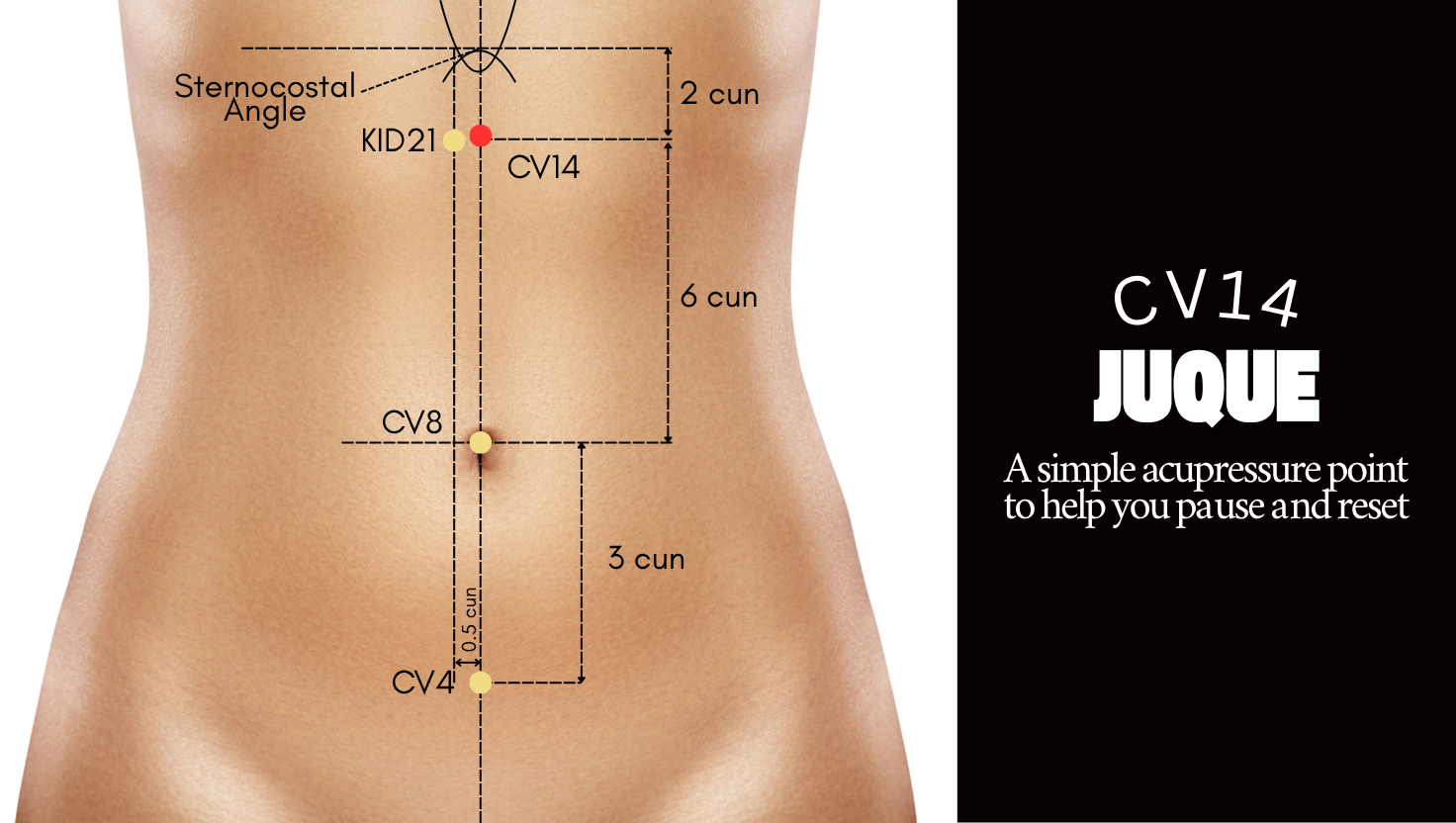
Located along the centerline of the upper abdomen, CV14, or Juque, has traditionally been used in Chinese medicine for patterns involving the chest, upper abdomen, restlessness and emotional unease.
Modern research does not show that pressing CV14 alone treats anxiety or another medical condition. But self-acupressure can still serve a practical purpose: it encourages you to stop, breathe and notice what is happening in your body.
Sometimes that is exactly where relaxation begins.
First, Try It for Yourself
You can explore CV14 at home in just a minute or two.
Find the general area
CV14 is located:
- along the centerline of your body
- above your belly button
- below the lower end of your breastbone
In professional acupuncture, practitioners use precise proportional measurements to locate the point.
For gentle home acupressure, you do not need to be millimeter-perfect. Stay around the upper abdominal midline and focus on comfort.
How to Use CV14 at Home
Find a quiet place where you can sit or lie comfortably.
Step 1: Settle
Let your shoulders drop and loosen anything restrictive around your waist or abdomen.
Step 2: Find the area
Place one or two fingertips gently on the centerline of your upper abdomen, below your breastbone.
Step 3: Apply light pressure
CV14 is not a point that needs forceful pressure.
Use a gentle touch that feels comfortable.
Step 4: Breathe
Take a slow, comfortable breath in through your nose.
As you exhale, let your abdomen soften underneath your fingers.
Continue for about 20-30 seconds.
Step 5: Release and notice
Remove your fingers.
- Before immediately moving on, ask yourself:
- Did my breathing slow down?
- Does my abdomen feel less braced?
- Are my shoulders sitting differently?
- Do I feel even slightly calmer than I did a minute ago?
You can repeat the exercise once or twice if it feels comfortable.
Turn It Into a 2-Minute Reset
Try this when you notice yourself becoming tense during the day:
Place your hand over CV14.
Inhale comfortably.
Exhale a little more slowly.
Let your shoulders soften.
Unclench your jaw.
Repeat for several breaths.
That’s it.
You don’t have to force yourself to relax or clear your mind.
Simply give your body two minutes without another task competing for your attention.
When Might You Try CV14?
You might experiment with this short routine:
After a stressful workday
Use it as a transition between work mode and home mode.
Before bed
Try it after putting your phone down and before settling into sleep.
During a busy afternoon
Pause between meetings or tasks instead of immediately reaching for another screen.
When you catch yourself holding your breath
Stress and concentration can sometimes make breathing feel shallow. Use CV14 as your reminder to soften.
During a gratitude practice
Place a hand gently over the area and think of one thing from your day that you appreciated.
It does not have to be profound.
A good meal.
A kind conversation.
Finishing something difficult.
A quiet moment.
Why Is CV14 Used in Chinese Medicine?
Within traditional Chinese medicine, CV14 is known as the Front-Mu point of the Heart.
Historically, practitioners have used it within acupuncture treatment plans for patterns involving:
- restlessness
- emotional agitation
- chest sensations
- palpitations
- nausea
- digestive discomfort
- upper abdominal symptoms
Traditional Chinese medicine also connects the Heart with the Shen, a concept often translated as the mind or spirit.
This is part of traditional Chinese medicine theory and should not be interpreted as proof that emotions physically collect at CV14 or that stimulating one point can treat a medical or mental-health condition.
Professional acupuncture also rarely depends on a single point.
A practitioner looks at the whole pattern.
Acupressure at Home vs. Acupuncture in the Clinic
This is where things become more interesting.
Acupressure gives you a simple way to explore a point yourself.
Professional acupuncture goes further.
Instead of choosing one point based on one symptom, a licensed acupuncturist can look at factors such as:
- where you hold tension
- how well you sleep
- your energy patterns
- digestion
- headaches or muscle tightness
- stress levels
- recurring symptoms
- how your concerns interact with one another
Your treatment can then include a combination of acupuncture points selected specifically for you.
That means CV14 might be appropriate for one person but only one small part of a broader treatment plan for another.
Try This Tonight
Before bed tonight, take two minutes.
Sit somewhere comfortable.
Place your hand gently over CV14.
Take five relaxed breaths.
With each exhale:
soften your jaw
drop your shoulders
let your abdomen relax
Then notice how you feel.
You may experience a noticeable sense of calm.
You may simply become aware of tension you hadn’t noticed before.
Or you may feel very little.
All of those responses are okay.
Acupressure is not about forcing your body to produce a particular feeling.
It’s about paying attention.
Want to Explore Acupuncture More Deeply?
If this simple acupressure exercise feels good, professional acupuncture offers an opportunity to explore that experience in a more personalized way.
At Kokin Healing Center, acupuncture treatments are tailored around the individual rather than a single point or symptom.
Your practitioner can look at the bigger picture, including stress, tension, sleep, discomfort and other concerns, and select acupuncture points based on your particular needs.
Think of CV14 as a small introduction to a much larger system of care.
You can try one point at home.
Then, when you’re ready, experience what happens when treatment is designed specifically for you.
Safety
Use only gentle pressure over CV14.
Avoid pressing the area if you have:
- unexplained or severe abdominal pain
- significant tenderness or swelling
- a recent abdominal or chest injury
- recent surgery in the area
- a medical condition for which you have been advised to avoid abdominal pressure
If you are pregnant, ask your healthcare professional or licensed acupuncturist before experimenting with unfamiliar acupressure points.
Stop if pressure causes pain or discomfort.
Symptoms such as chest pain, difficulty breathing, severe abdominal pain, persistent palpitations or other concerning symptoms should receive appropriate medical evaluation rather than being treated as stress or managed through acupressure alone.
Never attempt to needle CV14 yourself. Acupuncture should be performed by a properly trained professional.
A Small Practice Can Be a Starting Point
You don’t need an hour-long wellness routine to notice what your body is doing.
Sometimes it begins with one minute.
One point.
Five slower breaths.
CV14 gives you an easy opportunity to experiment with acupressure and experience one of the principles behind acupuncture firsthand: paying attention to the relationship between tension, breathing and how you feel.
Try it the next time your day feels particularly full.
And if you’re curious about what a personalized acupuncture treatment could feel like, the next step is just as simple.
